
THE OPERUM TRACK RECORD
The framework is built on direct operational leadership — not borrowed methodology.
These outcomes came out of running operations inside law firms and large service organizations — the same work the framework was built from. Firm names are withheld; the numbers aren't.
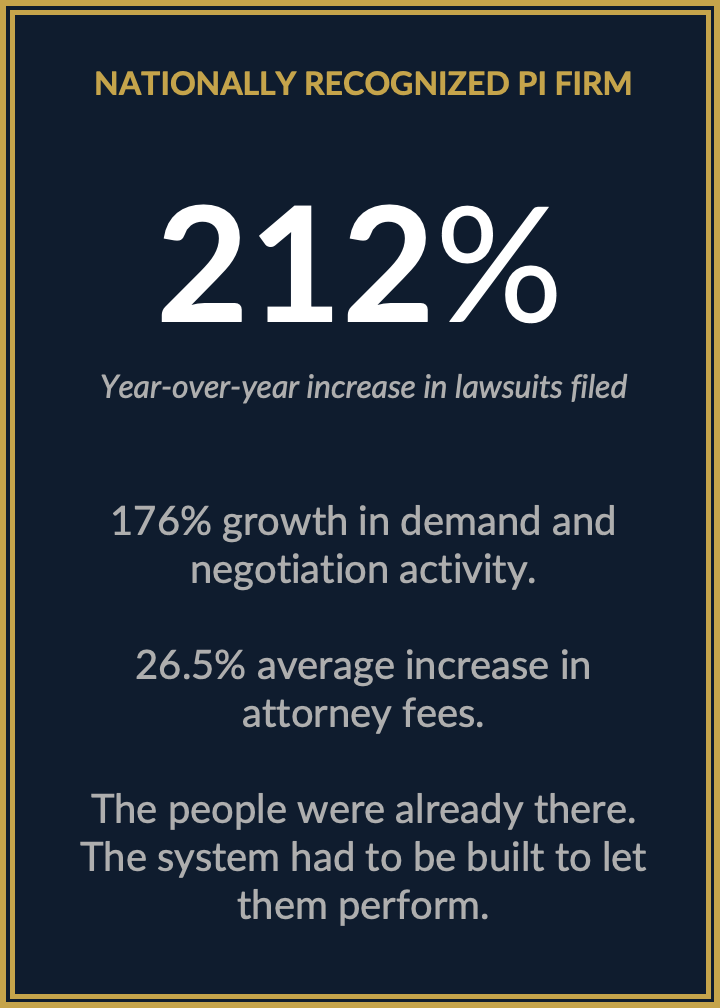
WHAT WAS HAPPENING:
The firm had strong attorneys and a growing client base, but leadership was spending the majority of their time inside individual files rather than running the business. Intake was inconsistent — some leads converted, many didn't, and nobody could say why. Attorney time was being consumed by tasks that had nothing to do with legal work. The firm was profitable, but it was working significantly harder than it needed to for those results.
WHAT CHANGED:
The engagement began with an infrastructure rebuild. Intake was redesigned from first contact through case acceptance, with clear ownership, defined conversion standards, and a feedback loop for what was and wasn't working. Attorney roles were realigned around the work that required their expertise — and a parallel structure was built to handle everything that didn't. A performance measurement system gave leadership real-time visibility into where the firm stood at any point in the month.
WHAT DROVE THE RESULT:
When attorneys are spending their time on attorney-level work, and intake is converting at a higher rate with a defined process, output grows — without adding headcount proportionally. The 212% increase in lawsuits filed wasn't the result of hiring more people. It was the result of the existing team finally being able to do the work they'd already been hired to do.
WHAT WAS HAPPENING:
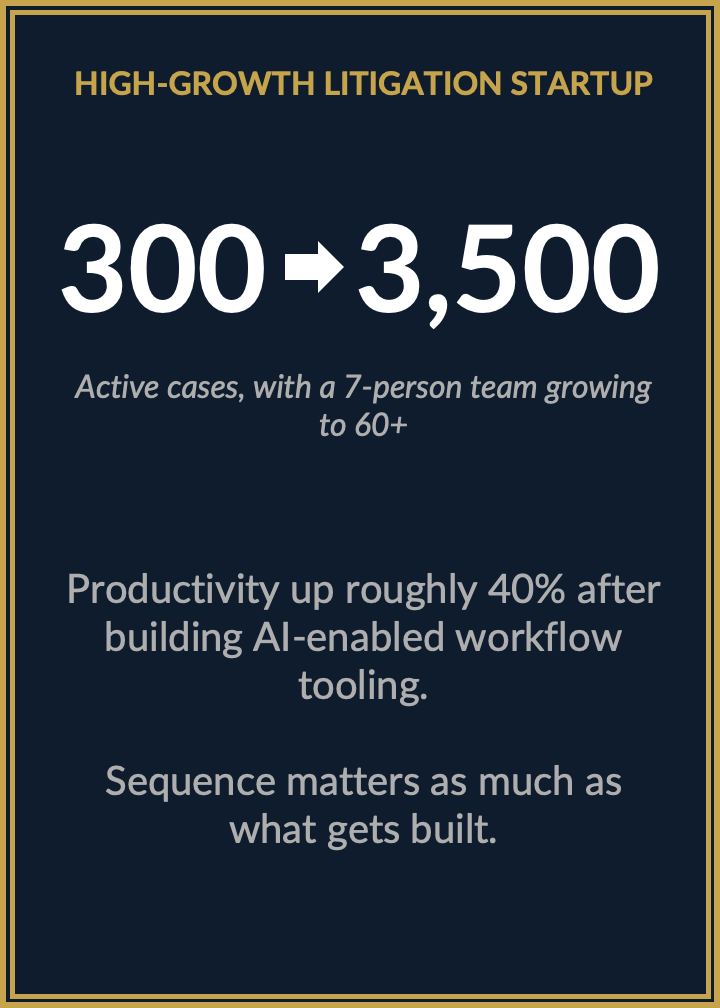
The firm had identified a significant market opportunity and was growing aggressively — faster than the internal structure could keep up with. At 300 cases with a small team, the founder could personally track every matter. At 800 cases, that stopped being possible. By the time outside help was brought in, cases were moving through the firm inconsistently, new hires were onboarded without a real process, and leadership was spending more time managing internal confusion than managing the business.
WHAT CHANGED:
The operational build happened in parallel with the growth — which required building infrastructure fast enough to stay ahead of the incoming volume. Case management workflow was designed first, establishing how every matter moved from intake through resolution regardless of who was handling it. A shared services model was built to create operational leverage across the growing headcount. Role design was deliberately sequenced so that every new hire had a defined process to step into from day one.
WHAT DROVE THE RESULT:
Scaling a team from 7 to 60+ people only works if there's a system for new people to operate inside. Without it, every hire increases complexity. With it, every hire increases capacity. The 300 to 3,500 case growth happened because the firm built the infrastructure first — and then grew into it, rather than trying to retrofit structure onto a firm that had already outgrown it.
WHAT WAS HAPPENING:
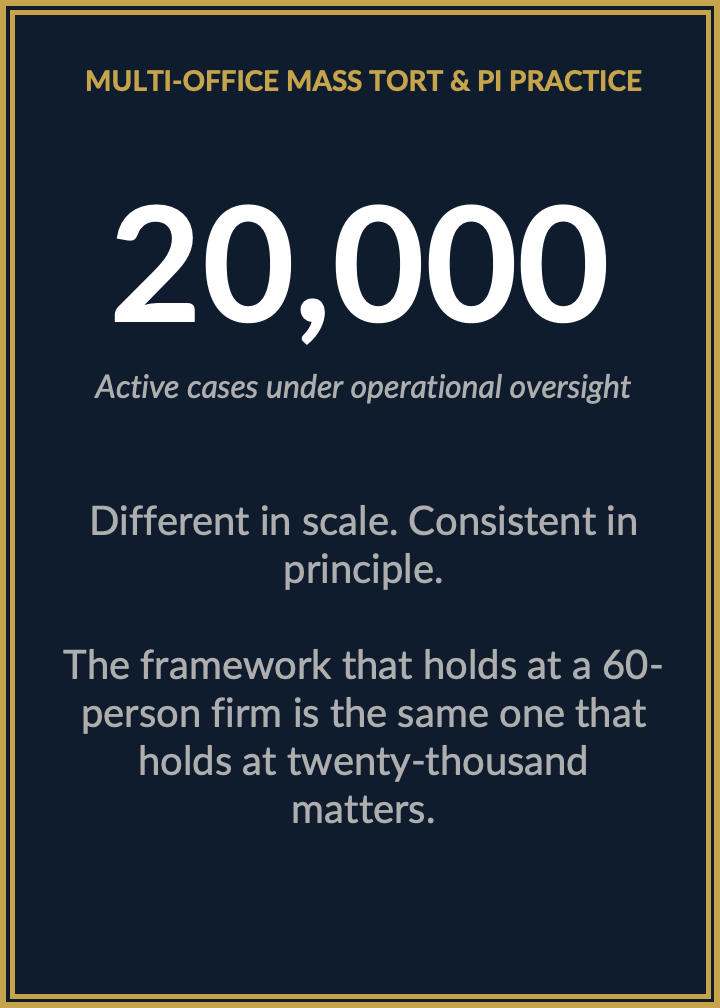
At scale, the challenge isn't building a system — it's keeping it aligned across multiple offices, practice areas, and leadership layers. The firm had strong operations in pockets, but no consistent standard across the organization. Performance varied significantly by office and by team, and leadership had limited real-time visibility into what was driving the differences. Decisions about resource allocation, hiring, and case strategy were being made without a shared data foundation.
WHAT CHANGED:
The focus at this scale shifted to operating rhythm and performance infrastructure. A unified KPI framework was designed that could surface meaningful data at the office, team, and firm level without requiring a reporting analyst in every location. Leadership review cadences were standardized so that every managing partner was working from the same operational picture. The six pillars were applied not as a first-time build, but as a diagnostic and alignment framework — identifying where the standard was holding and where it had drifted.
WHAT DROVE THE RESULT:
At 20,000 cases, the margin for inconsistency is enormous. A 5% improvement in case progression velocity or a 3% improvement in intake conversion doesn't register in a small firm — it's transformative at this scale. The work at this level is about building the systems that make consistency possible across distance and complexity, and giving leadership the visibility to see it in real time.

READY TO BUILD IT
The next step is a conversation.
A direct read on what’s actually slowing the firm down — and a clear view of where to focus first. No pitch.